
Have you ever noticed how the gentle sound of rainfall, soft ambient music or a steady background hum can make it easier to unwind at the end of a busy day? Sound can influence how relaxed we feel, and researchers are continuing to explore how different sounds interact with the sleeping brain.
Ambient sound is often used as part of a bedtime routine to create a peaceful environment, mask distracting noises and encourage relaxation. But how does it affect brainwaves during sleep, and can the right soundscape help us rest more comfortably?
Understanding Brainwaves and Sleep
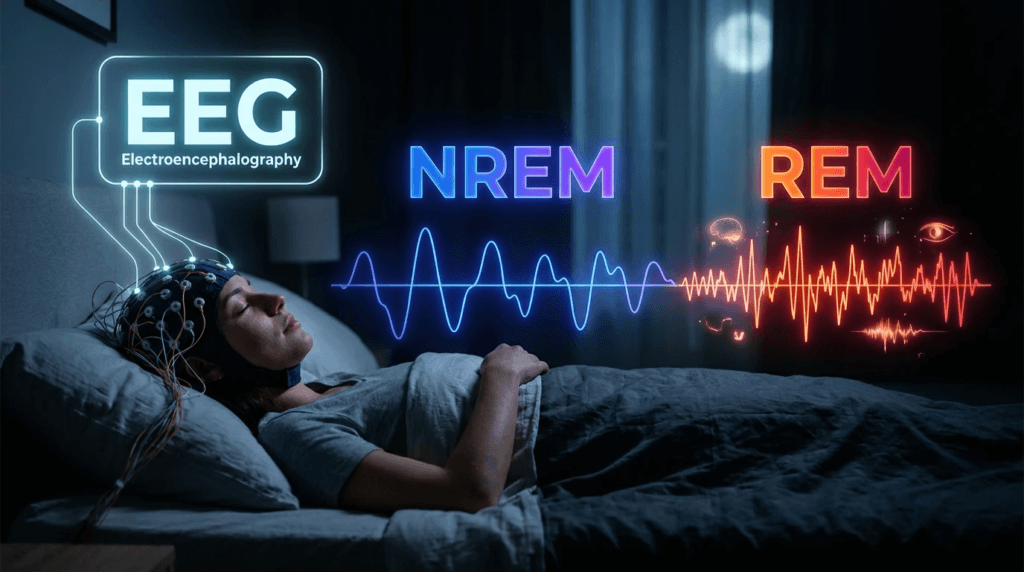
Brainwaves are patterns of electrical activity produced by groups of nerve cells in the brain. They can be measured using a technique called electroencephalography (EEG), which helps researchers understand changes in brain activity during sleep.
Sleep is not a single, uniform state. Throughout the night, we move through different stages of non-rapid eye movement (NREM) sleep and rapid eye movement (REM) sleep. Each stage has its own characteristic patterns of brain activity.
Three commonly discussed brainwave patterns include:
- Alpha waves: Generally associated with relaxed wakefulness, particularly when your eyes are closed and you are winding down.
- Theta waves: Commonly observed during lighter stages of sleep and periods of drowsiness.
- Delta waves: Slow brainwaves strongly associated with deep, slow-wave sleep.
These patterns naturally change as we move through the sleep cycle. Ambient sound does not simply switch the brain into a particular state, but sounds can influence how the brain responds to its surroundings, even when we are asleep.
How Ambient Sound Interacts With the Sleeping Brain
Although we become less aware of our surroundings during sleep, the brain does not completely stop processing sound. It continues to respond to certain auditory signals, and sudden or disruptive noises can sometimes cause brief awakenings or changes in sleep activity.
A consistent, gentle soundscape may help by making the sleeping environment feel more predictable. For example, rainfall, soft instrumental music or steady background noise can mask intermittent sounds such as distant traffic, household activity or other environmental distractions.
This may be particularly helpful for people who find sudden changes in background noise disturbing. However, responses vary from person to person, and continuous sound does not improve sleep for everyone.
The important distinction is that ambient sound may support a comfortable sleep environment, but it should not be assumed to directly produce deeper sleep or a particular brainwave pattern.
Different Types of Ambient Sound and Their Potential Benefits
Different sounds create different listening experiences. Finding one that feels comfortable is often more useful than searching for a supposedly perfect frequency.
Nature sounds
Gentle rainfall, rustling leaves and flowing water can create a soothing atmosphere. Some people find these sounds calming because they provide a steady listening experience without the changing dynamics of everyday noise.
Ambient instrumental music
Slow, gentle instrumental music can help establish a relaxing bedtime routine. Soft melodies, sustained notes and gradual transitions may encourage listeners to unwind before sleep. Music with abrupt changes, dramatic crescendos or strong rhythms may be less suitable for those who prefer a consistent background.
White noise and pink noise
White noise contains a broad range of audible frequencies at approximately equal intensity per frequency interval, while pink noise has relatively more energy at lower frequencies. Both are commonly used to mask environmental sounds, although their effectiveness varies.
Some listeners prefer the brighter quality of white noise, while others find pink noise softer and more comfortable. The best choice depends on individual preference, sensitivity to sound and the environment in which it is used.
Can Ambient Sound Encourage Deeper Sleep?
This is an important question, particularly for anyone exploring soundscapes as a natural part of a bedtime routine.
Deep sleep is associated with slow-wave activity, including prominent delta waves. Researchers have investigated whether carefully timed auditory stimulation can influence this activity. Some findings are promising, but experimental techniques and results vary, and they should not be confused with simply playing ambient music throughout the night.
For everyday listeners, the more practical goal is to create an environment that feels calm and minimises unwanted interruptions. If a gentle soundscape helps you relax and makes background noises less noticeable, it may be a useful addition to your sleep routine.
It is also worth remembering that louder is not better. Keep playback at a comfortable, low volume, and choose sounds that remain pleasant rather than distracting.
Creating a Calming Bedtime Sound Environment
If you would like to explore ambient sound for sleep, start with a few simple steps:
- Choose a sound that you genuinely find relaxing, whether it is soft instrumental music, rainfall or a steady noise track.
- Keep the volume low enough that it does not become the focus of your attention.
- Look for smooth transitions and consistent sound levels rather than sudden changes.
- Give yourself time to discover whether the sound helps you settle, while remembering that silence may work better for some people.
- Combine your chosen soundscape with other helpful habits, such as dimming the lights and keeping a regular bedtime.
Consistency can make a bedtime routine easier to follow, but there is no single sound or frequency guaranteed to improve everyone’s sleep.
Final Thoughts
Ambient sound offers an interesting connection between our listening environment, relaxation and the sleeping brain. Although research has not established that ordinary soundscapes reliably improve sleep or control brainwaves, gentle audio may help some people feel more comfortable and less distracted at bedtime.
The key is to choose sounds that suit your preferences and use them as one part of a wider approach to healthy sleep.
For more ideas about choosing calming audio, explore our main guide to AI-driven sleep soundscapes, where we look at how atmospheric audio can be used to create an immersive and relaxing listening experience.
You can also explore the atmospheric sleep music from Calmnox Audio, created for quiet evenings, peaceful listening and moments of calm.